

table of contents
Content Strategy for SEO: Why It Is the Backbone of Success
Contractors face a visibility problem because most local leads start with a search and organic placement determines who gets the call, and schema markup for construction businesses gives search engines clear signals about services locations and trust so you can compete more effectively.
Aggregator platforms dominate search engine results pages by buying prominent placements and aggregating reviews and service listings, and that presence pushes many independent contractors below the fold and into paid lead models.
Homeowners search with high intent and use service-specific queries when they need work done now, and they expect quick answers about availability, pricing, and credibility, which makes capturing those queries essential for steady business.
Schema markup for contractors is the structural reinforcement of your digital foundation because it makes business details machine-readable and increases the chance that Google will surface rich results, local pack entries, and review snippets that match homeowner intent.
Key Takeaways
- Schema is a competitive differentiator in contractor SEO, helping you outrank aggregators and dominate local intent queries.
- Service‑level schema builds topical authority, allowing contractors to rank for specific, high‑value jobs instead of generic categories.
- Structured data enhances trust signals, improving click‑through rates, review visibility, and the perceived legitimacy of your business.
What Schema Markup Actually Does
The Contractor Schema Stack: What You Should Implement First
1. LocalBusiness Schema Non negotiable
What to add NAP – name, address, and phone, exactly the same everywhere. Service area list towns and zip codes you serve. Geo coordinates add latitude and longitude, so Google knows your exact location. Licenses and certifications show any state or trade licenses and insurance. Payment types list cards, checks, and financing options. These items tell Google who you are, where you work, and how customers can pay which makes your business eligible for local features and knowledge panels
2. Service Schema Your topical authority engine
What to add – Create a schema block for each individual service page and label the exact job with job-specific markup, such as installation, repair, or inspection. This tells Google the page is about landscape lighting installation in Castle Rock rather than a general landscaper page and helps you match very specific homeowner queries. Service schema turns each service page into a clear signal for local intent and topical relevance
3. Review Schema
What to add – Pull in aggregate ratings and include review counts and average score. Contractors benefit more than many local businesses because visible trust signals reduce friction for homeowners who hire tradespeople. Showing stars and a review count in search results makes a listing look safer and more clickable, which often leads to more calls and booked jobs
4. FAQ Schema
What to add – Add homeowner questions and short answers that address common concerns about timing, pricing, permits, and warranties.The FAQ schema reduces friction by answering questions in the search result, and it increases SERP real estat,e so your listing takes up more space and pushes aggregators down the page
5. ImageObject Schema
What to add – Mark up before and after photos and project galleries with ImageObject schema and include captions and location details. This reinforces local relevance and helps Google understand that the photos are real projects in your service area, which supports local discovery and trust
Table: Schema Types vs. Contractor Benefits
| Schema Type | Primary Benefit | Why It Matters for Contractors |
|---|---|---|
| LocalBusiness | Stronger local visibility | Competes with aggregators |
| Service | Service level ranking power | Captures high-intent job searches |
| Review | Trust + CTR lift | Homeowners choose based on trust |
| FAQ | Rich results and reduced friction | Answers common homeowner concerns |
| ImageObject | Visual proof of craftsmanship | Builds credibility instantly |
Implementation Guide: How Contractors Can Add Schema Without Breaking Their Site
Tools for generating schema
Use a simple JSON-LD generator or a WordPress plugin so you do not hand-code everything. Many guides recommend plugins and theme-level options for WordPress sites because they reduce mistakes and make updates easier. If you prefer manual control, you can use an online JSON-LD generator and copy the code into your site templates or a custom HTML block. Important point: pick a method that matches your comfort level and your developer access.
| Tool type | Ease of use | Best for |
|---|---|---|
| Plugin based schema | Very easy | Non-technical site owners |
| JSON LD generator | Moderate | Developers who want control |
| Theme built schema | Easy and moderate | Sites using Avada Elementor or Astra |
How to validate
Validation is simple and required. Paste your JSON-LD into Google’s Rich Results Test or the Schema Markup Validator to check for errors and warnings. Fix any missing required fields, such as name, address, or service area, and then retest until the tool shows no critical errors. Important point: always validate before you deploy and again after you publish so you catch copy-paste mistakes.
How to maintain schema as services evolve
Treat schema like a living checklist. When you add a new service page, add a Service schema block and update your LocalBusiness service area and payment types. Keep review counts current by wiring your review system into the schema or by updating aggregate ratings when you hit new milestones. Revalidate after each change and monitor Google Search Console for structured data errors and rich result impressions. Important point: Schedule a quick schema check whenever you change service pricing or service area so your structured data stays accurate.
Where Schema Delivers the Most Impact for Contractors
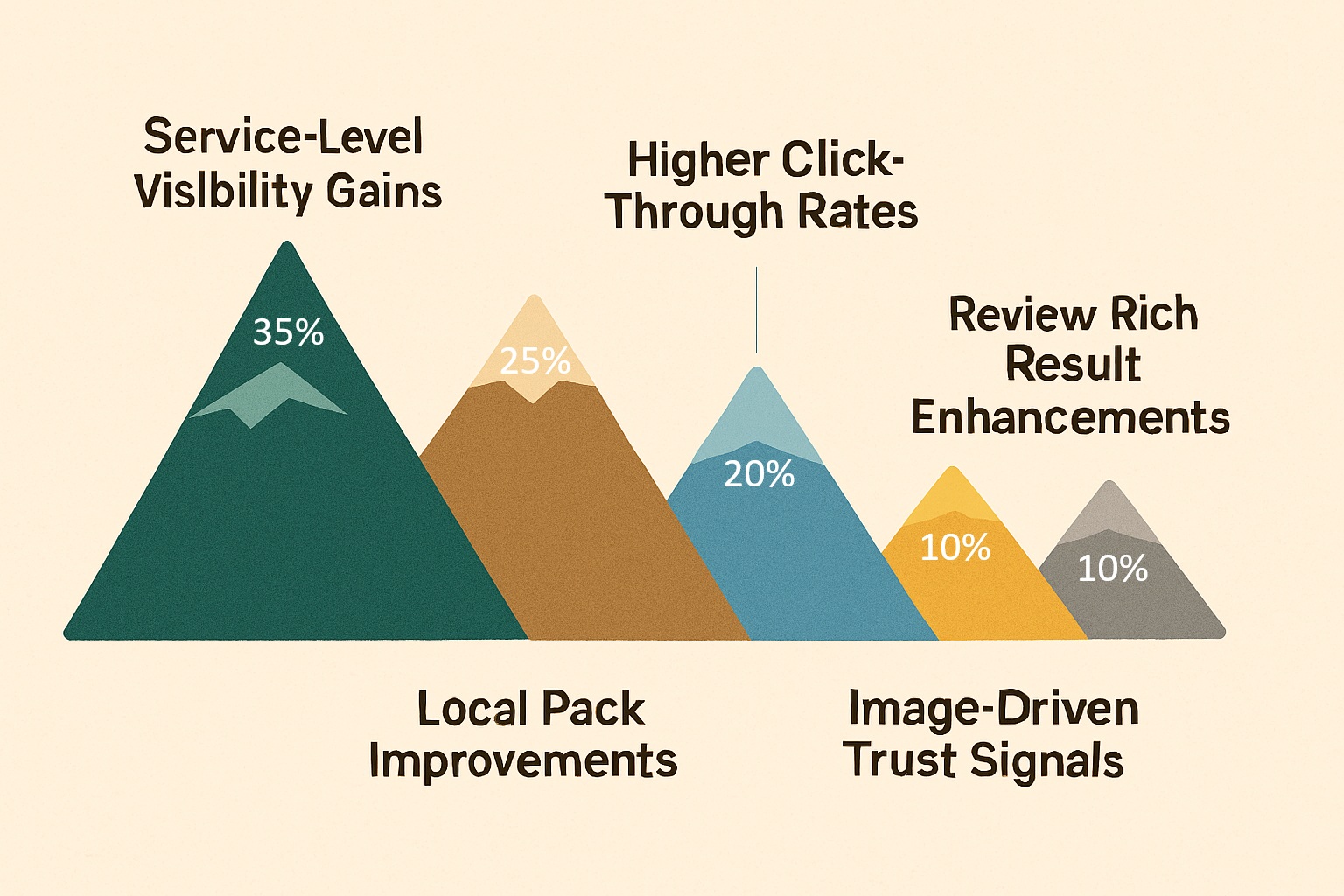
The mountain graph shows which parts of your online presence get the biggest boost when you use schema markup for construction businesses. The largest gain comes from service level visibility because schema helps Google understand exactly what you do, so you show up for more of the right searches. The next biggest improvement is in the local pack, where accurate structured data makes Google trust your business information and show you to nearby customers more often. Schema also improves click-through rates because your listing looks clearer and more helpful, which encourages people to choose you over another contractor. Smaller but still important benefits come from review enhancements and image-driven trust signals since stars and project photos help customers feel confident in your work before they even visit your site. Together, these improvements show that schema strengthens visibility, trust, and conversions in a simple and practical way.

Conclusion
Schema is not flashy, but it is the foundation that makes your website speak the same language as search engines, and schema markup for construction businesses quietly boosts the chances that local customers find and trust you. Contractors who add it tend to get more calls and clicks than those who do not, because structured data lets search results show service area, offers, project examples, and contact details right where people look. It strengthens visibility and trust, and it helps turn searches into real jobs, and best of all, it keeps working and stacking up value as you add more pages and projects. For contractors, structured data is not optional; it is practical infrastructure that pays off over time.
Non‑Surface‑Level Keywords + Definitions
Entity‑First Indexing
Google’s shift toward understanding businesses as entities rather than pages. Schema accelerates entity recognition, which boosts trust and ranking stability.
Semantic Service Clustering
Grouping related contractor services through structured data so Google understands the hierarchy and relationships between offerings (e.g., “landscape lighting” → “outdoor lighting” → “exterior home services”).
Attribute‑Level Relevance Signals
Micro‑details inside schema (payment types, service areas, materials used) that help Google match your business to hyper‑specific homeowner queries.
SERP Feature Eligibility
The set of enhanced search result formats your site becomes eligible for once schema is implemented — FAQs, reviews, images, local packs, etc.